If we’re completely honest with ourselves, childhood is the most powerful stage of human life. We are the most connected to our authentic selves and tapped into our imaginations. We all have memories of our childhoods that are filled with wonder and curiosity. We asked questions like why the sky is blue, how birds fly, and why the moon follows us.
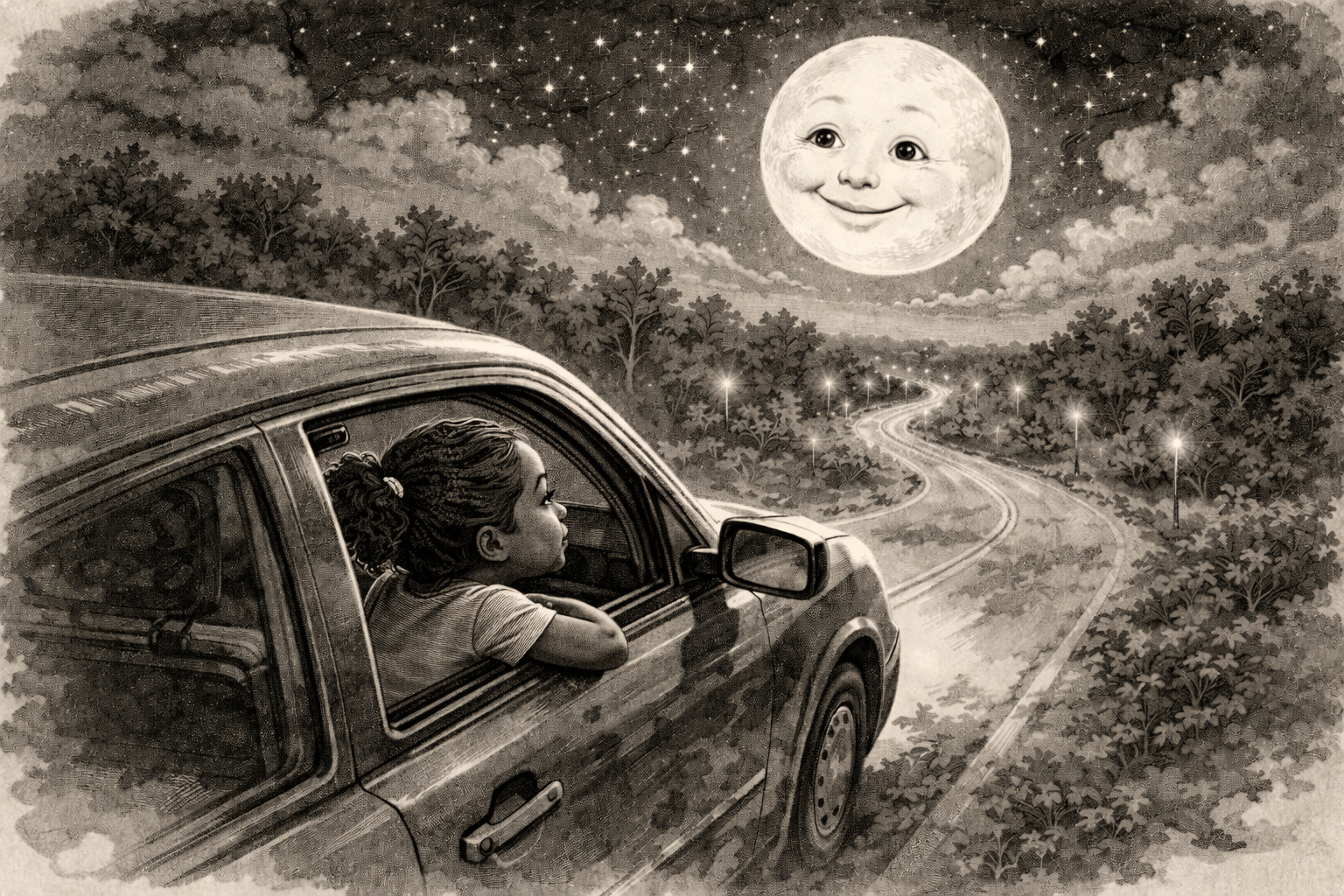
One of the first mysteries many of us encounter as children is the moon. You notice it one night through the car window, hanging low and luminous, and then—somehow—it’s still there as you turn corners, cross bridges, drive farther than seems possible. It appears to follow you. Naturally, you ask why.
The adults in your life might offer explanations: perspective, distance, optics. All true, of course. But rarely satisfying. Because the question isn’t really about astronomy. It’s about wonder. It’s about the peculiar feeling that the world is paying attention to you—or at least participating in your noticing of it.
As children, we are generous with these kinds of questions. We ask them without embarrassment or urgency. We don’t need answers right away. We’re content to let the mystery ride along beside us, keeping pace, illuminating the dark just enough to make it interesting.
Somewhere along the way, we’re taught to stop asking. Or rather, we’re taught which questions are acceptable. Practical ones. Productive ones. Questions with clear outcomes. The rest—the moon-following-us kind—are gently dismissed as fanciful, inefficient, or beside the point.
But the truth is, these questions are often the first ones that teach us how to think.

The moon doesn’t follow us, not really. But the feeling that it does is an early lesson in perception: that the world looks different depending on where you stand, how fast you’re moving, what you’re paying attention to. That reality is not only what is, but how we experience it.
Adults, for all our accumulated knowledge, are sometimes less comfortable with this idea. We prefer certainty. Fixed answers. A sense that we’ve arrived somewhere stable. Wonder can feel destabilizing—it asks us to admit that we don’t fully understand the world we inhabit, even after years of living in it.
And yet, wonder persists.
It shows up in quiet moments: watching a shadow stretch across a room, noticing how light changes at different hours of the day, realizing that a song you’ve heard a hundred times suddenly means something new. These moments don’t demand solutions. They ask only for attention.
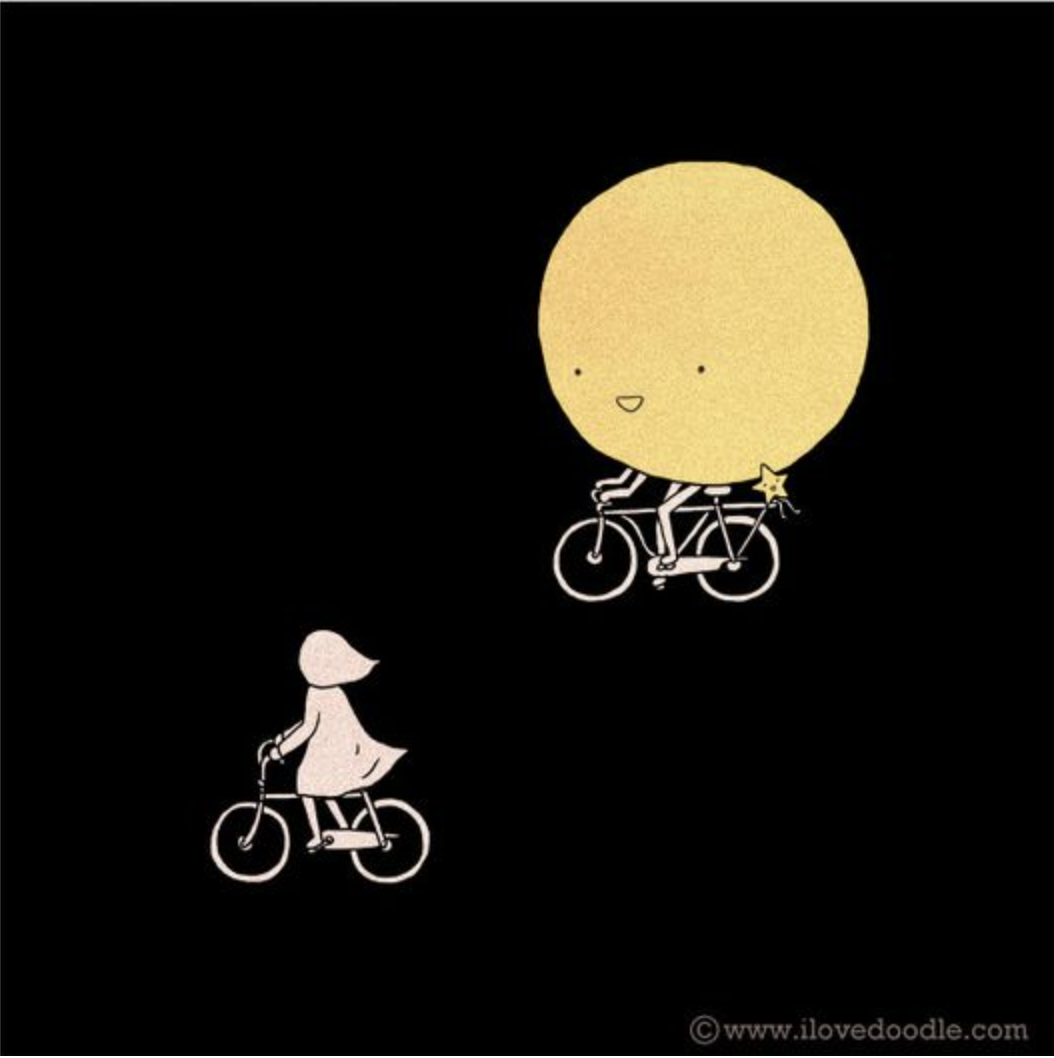
The moon, steadfast in its apparent pursuit, becomes a kind of companion in this regard. It reminds us that not everything meaningful needs to be explained away. Some things are worth keeping slightly out of reach—not because they’re unknowable, but because the act of wondering keeps us awake to the world.
Perhaps that’s why the question stays with us. Not because we never learned the answer, but because we learned something more important: that curiosity doesn’t end when a mystery is solved. It deepens. It changes shape. It follows us—much like the moon—quietly insisting that there is still more to notice.
The moon isn’t the only thing that behaves this way at night. Fireflies blink on and off as if signaling to one another—or to us—without explanation. Stars hold steady, ancient and unreachable, yet close enough to invite naming and myth. Even porch lights draw moths into slow, spiraling orbits, a quiet choreography that feels deliberate despite its randomness. These small illuminations interrupt the dark just enough to feel intentional, as if the night itself is participating in a kind of gentle conversation. They remind us that not everything meaningful announces itself loudly; some things glow softly, briefly, asking only that we notice before they disappear.
And maybe that’s the real gift of the question. Not the explanation it invites, but the way it trains us to look up, again and again, and trust that there is value in paying attention to what seems to be moving with us through the dark.
Tiffani