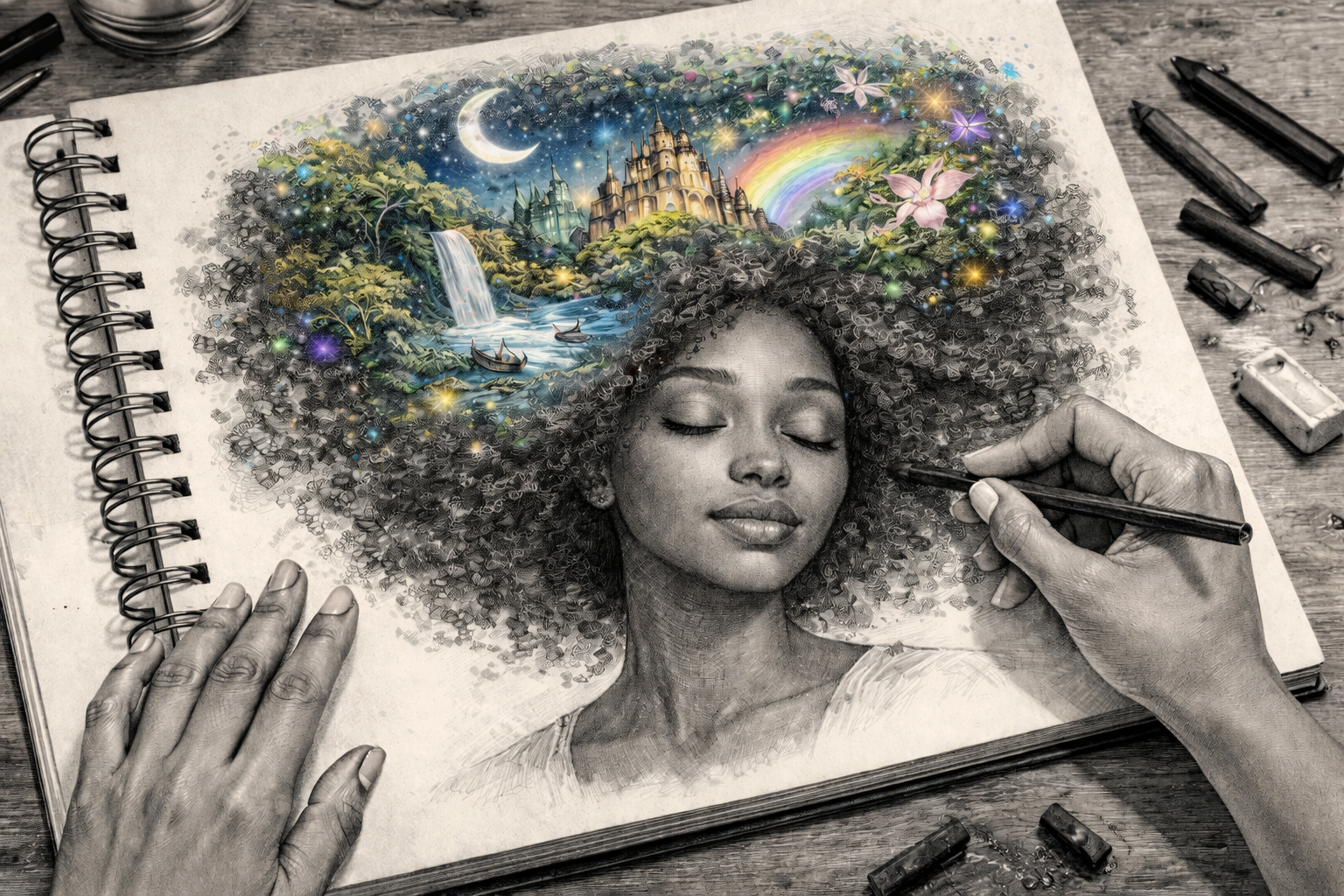

I don’t remember when it happened.
Only that one day, I noticed my imagination had gone.
There was no announcement, no clear ending. I didn’t know I was doing certain things for the last time—playing without purpose, wandering without a destination, inventing worlds simply because I could. Most endings don’t arrive with ceremony. They slip past us unnoticed, only becoming visible in hindsight.
That’s the strange thing about growing up: we’re taught to focus on what we’re becoming, rarely on what we’re leaving behind. Progress is framed as accumulation—more skill, more certainty, more control. But no one tells you that along the way, you may misplace parts of yourself that once came easily. Curiosity. Wonder. The quiet confidence of imagining without needing permission.
Lately, I’ve been thinking about imagination not as something we possess, but as something we connect to—a state of being, a way of thinking that moves through us when we make room for it. A faculty that doesn’t need to be unlocked so much as re-entered. Something that never fully disappears, even when it falls silent—waiting for the conditions that allow it to speak again.
When we’re young, imagination feels less like a skill and more like an atmosphere. We move through it without thinking. It doesn’t announce itself as imagination—it’s just how we make sense of the world. We ask questions. We invent explanations. We follow a thought simply because it’s interesting, not because it’s useful.
As her mind wandered, she imagined a world without limits where she could explore, create, and escape from reality. She thought about the possibilities of what could be - castles in the clouds, oceans in the sky, and gardens of fire. A sudden rush of energy filled her body as she embraced the power of her own imagination. Focusing on this newfound source of creativity, she found herself feeling calmer and more inspired than ever before.
Somewhere along the way, that way of moving through the world becomes harder to access. Not because it disappears, but because we’re taught to stand differently. To look for outcomes. To justify our attention. To trade wandering for efficiency. Imagination, in that shift, starts to feel indulgent. Optional. Something you either “have” or don’t. As if it were a possession that could be measured, evaluated, or put to work.
But I’m not sure that’s ever been true.
I think imagination is less something we own and more something we enter into—a way of relating to the world that requires a certain posture. Openness. Attention. A willingness to stay with a question a little longer than necessary. When those conditions disappear, imagination doesn’t leave. It simply goes quiet.
Adults are rarely asked to notice that silence. We’re praised for certainty, for speed, for answers delivered cleanly and on time. There’s very little room for thinking out loud, for following an idea without knowing where it leads, for letting curiosity set the pace.
And yet—every so often—it comes back online.
In moments of unguarded attention. In grief, or illness, or awe. In the spaces where control loosens and we’re forced to listen differently. Imagination returns not as spectacle, but as orientation. A way of sensing possibility again. A reminder of how we once knew how to move through uncertainty. Which makes me wonder if the task isn’t to “be more imaginative,” but to remember the conditions under which imagination speaks.

The version of myself that exists for the comfort and utility of other people doesn’t rely on imagination. It doesn’t need to. That self is designed to be legible, cooperative, and easy to place. I learned early on that new ideas and images rarely earn approval. What’s rewarded instead is compliance, smoothness, not asking too many questions. Curiosity and imagination are active forces. They carry energy. They interrupt. And when they aren’t welcomed, they don’t disappear—they go quiet. Whatever they might have become simply slips out of sight.
But imagination has never been loud power. It doesn’t announce itself or demand recognition. Its strength is quieter than that. It shows up as orientation rather than escape—a way of thinking that loosens what feels fixed and makes room where none seemed possible. Imagination doesn’t overpower the world; it changes how I move through it. It softens urgency, sharpens attention, and reminds me that more is available than what’s immediately visible. Not because anything is limitless—but because imagination teaches me how to see beyond what I’ve been told to accept.
Perhaps imagination doesn’t vanish so much as fall silent, returning only when we learn how to listen again.
Tiffani